Is Morocco safe? Most visits to Morocco are completed without a serious incident, but “safe” is not a permanent yes-or-no label. The useful question is what risks travelers are likely to encounter, which precautions reduce them and what current government advisories say at the time of travel.
Common visitor concerns include petty theft in busy areas, persistent sales pressure, misleading directions, road safety and unwanted attention. Government advisories also cover terrorism, demonstrations, local laws, natural hazards and region-specific issues that require more context than a social-media safety summary.
Check the current advisory issued by your own government before departure. PickYo’s summary supports trip planning; it does not replace official advice or travel insurance.
Quick Answer
| Situation | Practical approach |
|---|---|
| Busy medinas | Control valuables, expect crowds and clarify unsolicited help |
| Walking at night | Use familiar, populated routes and arrange transport when unsure |
| Taxis | Use official services and confirm the meter or fare arrangement |
| ATMs | Prefer bank-attached machines and reject unsolicited help |
| Demonstrations | Avoid gatherings and follow local instructions |
| Road travel | Avoid unrealistic night driving and check weather/road conditions |
| Solo travel | Plan arrival, accommodation access and evening transport carefully |
What Official Advisories Say
Advisories can change quickly, so PickYo should never freeze a warning level into evergreen copy without a date.
At the last editorial check, the U.S. Department of State advised travelers to exercise increased caution in Morocco due to terrorism. The UK Foreign, Commonwealth & Development Office covered terrorism, political demonstrations, petty and occasional violent crime, scams, local laws and natural hazards.
The correct response is not panic. Read the complete current advisory, understand whether it affects the places and activities in your itinerary and follow local authority instructions.
Petty Theft and Personal Belongings
Crowded medinas, transport hubs, beaches and busy squares require ordinary city awareness.
- Keep a phone and wallet out of open outer pockets.
- Do not hang a bag loosely from the back of a chair.
- Control luggage while buying tickets or checking a map.
- Carry only the cash needed for the day.
- Store a backup card separately.
- Avoid displaying expensive jewelry in crowded areas.
If a passport or important item is stolen, obtain a police report and contact the relevant consular service.
Scams, Hassles and Unsolicited Help
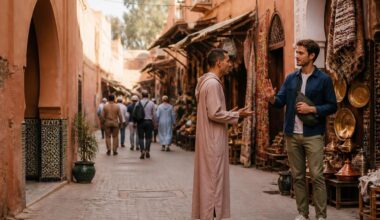
Not every difficult interaction is a scam, and presenting ordinary Moroccans as threats would be inaccurate. Problems are more likely in heavily visited areas where an unsolicited direction, guiding service or product demonstration becomes a demand for payment.
Useful habits:
- clarify whether help is a paid service;
- use licensed guides and official badges where required;
- agree on the price before an informal service begins;
- inspect the exact product being packed;
- leave calmly when pressure increases;
- ask accommodation staff for current local guidance.
Read our common Morocco scams guide for specific scenarios and calm, practical responses.
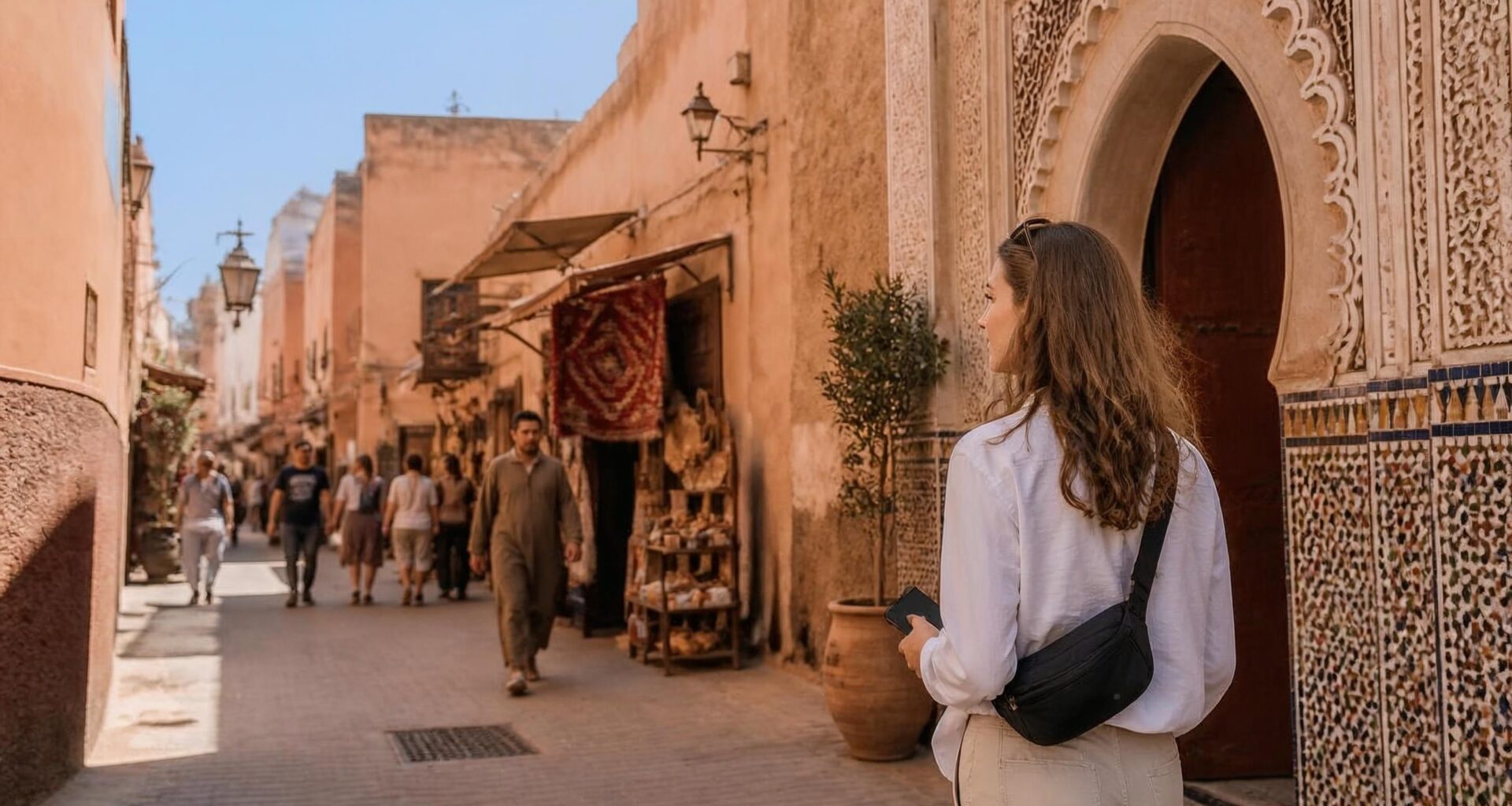
Walking in Medinas
Medinas are active neighborhoods and commercial centers, not theme parks. Narrow streets may include scooters, delivery carts and uneven surfaces.
- Save the accommodation name, phone number and nearest landmark offline.
- Ask for the simplest return route before leaving.
- Avoid following a stranger deep into unfamiliar lanes when the arrangement is unclear.
- Use populated routes after dark.
- Call the accommodation if you become disoriented near the riad.
Getting temporarily lost is common. It becomes a safety issue when a traveler is isolated, exhausted or unwilling to stop and reset the route.
Transport and Road Safety
Road risk is often more immediate than the dramatic threats emphasized online. Government guidance notes that mountain and rural roads can be narrow, steep or poorly lit and that weather can cause flooding or disruption.
- Build itineraries around realistic travel times.
- Avoid unfamiliar mountain routes after dark.
- Use seat belts where available.
- Choose reputable transport providers.
- Do not pressure a driver to maintain an unrealistic schedule.
- Check weather and local road information before remote journeys.
In cities, look carefully before crossing. Scooters and bicycles may approach from directions a visitor does not expect.
Women Travelers
Women, particularly when traveling alone, may receive unwanted comments or attention. Experiences vary, but dismissing the concern is not helpful.
Practical planning can reduce stress:
- choose accommodation with clear late-arrival instructions;
- arrange the first airport transfer when the riad is difficult to find;
- use populated routes after dark;
- wear clothing that fits both personal comfort and the local setting;
- do not feel obliged to answer intrusive questions;
- move into a hotel, restaurant or busy shop if an interaction becomes uncomfortable.
Read our solo female travel in Morocco guide for more detailed planning and current official resources.
Local Laws and Cultural Differences
Moroccan law and social expectations may differ from those in a visitor’s home country. Government advisories cover alcohol, drugs, photography, drones, public behavior and legal risks affecting LGBT+ travelers.
Travelers should review the current official guidance rather than rely on assumptions made from resort or social-media content.
During Ramadan, daily rhythms and opening hours can change. Eating or drinking publicly during fasting hours may cause offense in some settings even when services remain available to visitors.
Demonstrations and Major Events
Avoid political gatherings and demonstrations, even when they appear peaceful. Follow local media, police instructions and accommodation advice if a route is disrupted.
Large sporting events can also create traffic, crowds and occasionally disorder near stadiums. Plan extra travel time and avoid dense supporter gatherings when you are not attending the event.
Outdoor Activities and Weather
Morocco includes mountains, desert, coastline and areas exposed to flash flooding, extreme heat, cold nights, strong currents or wildfire risk.
- Use qualified operators for technical or remote activities.
- Check seasonal conditions, not only average temperatures.
- Carry enough water without underestimating heat.
- Do not enter flooded roads or wadis.
- Ask locally about beach currents and lifeguard coverage.
- Treat a desert night and a city afternoon as different packing problems.
Food, Water and Allergies
Choose food businesses with good hygiene practices and visible turnover. Travelers with serious allergies should contact restaurants in advance when possible, carry a written explanation and confirm ingredients repeatedly.
A translated phrase is useful but cannot guarantee the absence of cross-contamination. Medication and an emergency plan should follow professional medical advice.
If Something Goes Wrong
Before travel:
- save your insurer’s emergency number;
- record your embassy or consulate contact details;
- keep secure copies of important documents;
- know how to block payment cards;
- store accommodation details offline.
During an incident, move to a safe public place, contact the appropriate local service and obtain documentation for insurance where applicable.
Emergency numbers must be verified immediately before this page is published. PickYo should never display an old number without a visible check date.
Useful Darija
These five phrases remain text-only in this travel guide. For pronunciation, complete emergency phrases and free human-recorded audio, continue with Darija Emergency Phrases.
| English | Darija in Latin letters | Situation |
|---|---|---|
| No, thank you | La, shukran | Declining firmly |
| Leave me alone, please | Khallini, afak | Unwanted attention |
| Help me, please | Aawni, afak | Asking for help |
| Call the police | Ayyet l-bolis | Emergency |
| I am lost | Daa lia t-triq | Directions/emergency |
PickYo’s Recommendation
Morocco is a realistic destination for independent travelers who plan sensibly. Use official advisories for current risks, treat transport and road conditions seriously, manage belongings in crowds and prepare the first arrival into an unfamiliar medina.
Confidence comes from specific preparation, not from being told that a country is either completely safe or completely dangerous.
Related Guides
- Morocco Travel Tips
- Common Morocco Scams
- Solo Female Travel in Morocco
- Getting Around Morocco
- Morocco Taxi Guide
- Darija Emergency Phrases
Safety information last checked: 5 October 2026. Conditions and government advisories can change. Check the current advice issued by your own government before traveling. PickYo does not replace official safety, medical or legal advice.
Official Sources