Most interactions in Morocco are ordinary, helpful or commercial in the same way they are in other popular destinations. Problems are concentrated in busy tourist areas where a visitor is uncertain about prices, directions or local procedures.
This guide is not a list of reasons to distrust people. It explains recurring situations, the signal that an ordinary interaction is becoming uncomfortable and the simplest way to leave it.
The Basic Rule
Clarify the service and price before following, accepting or loading anything. A polite refusal made early is easier than negotiating after an unsolicited service has already been performed.
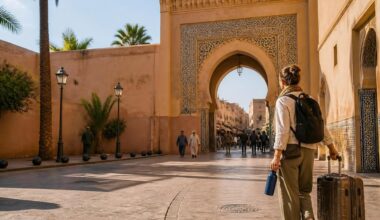
Unsolicited Directions in a Medina
What happens
Someone says a street is closed, offers a shortcut or begins walking with you, then asks for money at the destination.
Warning signal
The person continues after you decline or leads away from a busy route without explaining where you are going.
Calm response
Stop before following. Check the offline map, call the accommodation or ask inside an established shop. If you accept help, ask clearly whether payment is expected.
The Unofficial Guide
What happens
A person begins explaining a monument, tannery, market or neighborhood and gradually turns the interaction into a paid tour.
Warning signal
No official identification, no clear duration and no agreed fee.
Calm response
Use a licensed guide arranged through a recognized channel when you want a tour. The UK government advises checking that a guide in a historic district has an official badge and local authorization.
“The Road Is Closed”
Some closures are real. Medina lanes do close for work, prayer access, deliveries or local events. The problem is not the statement itself but being pressured to follow one particular person or shop.
Verify with accommodation staff, an official worker or more than one independent business before taking a long detour.
The Tannery or Cooperative Detour
What happens
A direction becomes a visit to a shop or cooperative where strong sales pressure follows.
Warning signal
You did not request the visit, the route keeps changing or leaving becomes socially difficult.
Calm response
Do not enter when the purpose is unclear. Inside a shop, remember that tea, conversation or a demonstration does not create an obligation to buy.
Product Substitution
What happens
The item wrapped after payment is not the same quality, size or design as the item inspected.
Warning signal
The product leaves your sight or is packed from another pile.
Calm response
Inspect the exact item before it is wrapped and check it again before leaving. Government travel advice specifically warns about inferior goods being substituted for purchased items.
Taxi Confusion
What happens
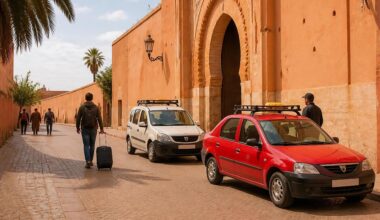
The fare, meter, destination or whether the quote covers one seat or a full grand taxi is not clear.
Warning signal
The car begins moving before the arrangement is understood.
Calm response
Confirm the destination and meter or price before loading luggage. At airports, use the official taxi counter or rank. For grand taxis, ask whether the amount is per seat or for the vehicle.
Luggage Help That Becomes a Charge
What happens
Someone lifts a bag at a station or medina gate and requests payment after carrying it.
Warning signal
The service begins without the traveler explicitly accepting it.
Calm response
Keep hold of the bag and decline immediately when help is not needed. When assistance is useful, agree on the service before handing it over.
ATM Assistance
What happens
A stranger offers to help with the machine, card or language settings.
Warning signal
Someone stands too close, asks to handle the card or directs the traveler to repeat a transaction.
Calm response
Cancel the operation, take the card and move to a bank-attached ATM. Ask bank staff for help during opening hours.
Card Amount or Currency Confusion
What happens
The amount shown on the terminal is different from the agreed total, or the traveler is encouraged to select conversion into a home currency without understanding the rate.
Warning signal
The terminal screen is hidden or confirmation is rushed.
Calm response
Read the amount and currency before entering the PIN. Ask for the transaction to be canceled when the total is wrong. Keep the receipt and enable payment notifications.
Photography and Animal Encounters
What happens
A photograph involving a performer, handler or animal becomes a demand for payment.
Warning signal
The price is not discussed before the photo.
Calm response
Ask permission and clarify the amount before taking the picture. Do not engage with animal experiences that conflict with your welfare standards.
Friendship, Romance and Online Contact
Government advisories warn that some travelers have experienced fraud, extortion or manipulation connected with relationships started online.
Protect your passport, return ticket, money and private information. Do not transfer money or surrender documents under pressure. Seek consular or legal advice when a situation becomes threatening.
How to Refuse Without Escalating
- Stop walking before the interaction becomes a service.
- Use a short refusal rather than a long explanation.
- Do not argue about whether the approach is a scam.
- Move toward a busy business, hotel or official point when pressure continues.
- Contact accommodation staff when you need reliable local help.
Useful Darija
These five phrases remain text-only in this travel guide. For pronunciation, extended refusal and emergency phrases, and free human-recorded audio, continue with Darija Souk Phrases and Darija Emergency Phrases.
| English | Darija in Latin letters | Use |
|---|---|---|
| No, thank you | La, shukran | Polite refusal |
| I’m just looking | Ghir kan-shuf | Shopping |
| Leave me alone, please | Khallini, afak | Firm boundary |
| I don’t want it | Ma bghitsh | Refusal |
| Where is the police? | Fin kayna l-bolis? | Seeking help |
PickYo’s Recommendation
Most difficult situations are easier to prevent than to resolve. Confirm the price and purpose early, keep control of money and belongings and use official or accommodation-recommended services when arriving somewhere unfamiliar.
Related Guides
- Is Morocco Safe?
- Morocco Taxi Guide
- Money in Morocco
- Morocco Souks Guide
- Darija Souk Phrases
- Darija Emergency Phrases
Safety information last checked: 5 October 2026. Situations and official advice can change. This guide describes common patterns without implying that ordinary commercial interactions are dishonest.
Official Sources