Fes is not simply an old city preserved for visitors. It is one of the places where Morocco’s political, scholarly, religious and craft traditions developed together—and where many of them are still visible in daily life. Understanding Fes means looking beyond famous gates and tannery views to the systems that made the city influential: water, learning, trade, migration and skilled work.
This portrait focuses on that identity. For transport, accommodation and trip-planning decisions, begin with our Morocco travel guide and Morocco train guide.
A city built around two communities
Fes developed from settlements associated with the Idrisid period at the end of the eighth and beginning of the ninth centuries. Communities arriving from Andalusia and Kairouan settled on opposite banks of the Oued Fes. Their neighbourhoods, skills and institutions helped turn the young city into an important urban centre.
The river and its network of springs mattered as much as the walls. Water supplied homes, fountains, gardens, workshops and places of worship. It also supported crafts that required washing and processing, including leather work. The medina’s dense plan can feel improvised to a first-time visitor, but it grew around practical relationships between water, markets, residential quarters, religious institutions and specialist trades.
Under Idris II, Fes became an early political centre. Later dynasties changed Morocco’s capital, expanded the city or built new royal quarters, yet Fes repeatedly regained influence. This is why it belongs among Morocco’s four imperial cities, alongside Marrakech, Meknes and Rabat.
Qarawiyyin and the culture of learning
The Qarawiyyin mosque and scholarly complex is central to the identity of Fes. Founded in the ninth century and enlarged over time, it became a major centre of religious learning. Students and scholars travelled to Fes from across Morocco and beyond, supporting libraries, manuscript culture, teaching and intellectual exchange.
Visitors should be careful with simplified claims that try to rank it neatly as the world’s “oldest university.” Modern institutions do not map perfectly onto medieval forms of learning. What is not in doubt is the exceptional continuity and influence of scholarship around Qarawiyyin.
That intellectual identity shaped the surrounding city. Madrasas such as Bou Inania and Al Attarine combined teaching, accommodation and devotional life with highly refined cedar carving, stucco and zellige. Their decoration was not added to make an attraction; it expressed the prestige attached to learning and patronage.
Fes el-Bali, Fes el-Jdid and the wider city
“Fes” is not one uniform historic district. Fes el-Bali is the oldest walled city and contains the dense commercial and religious core most visitors imagine when they hear “the medina.”
In the thirteenth century, the Marinids created Fes el-Jdid—New Fes—as a separate royal and administrative quarter. It included palaces, ceremonial spaces and, later, the Mellah traditionally associated with the city’s Jewish community. The Ville Nouvelle developed outside the old walls in the twentieth century.
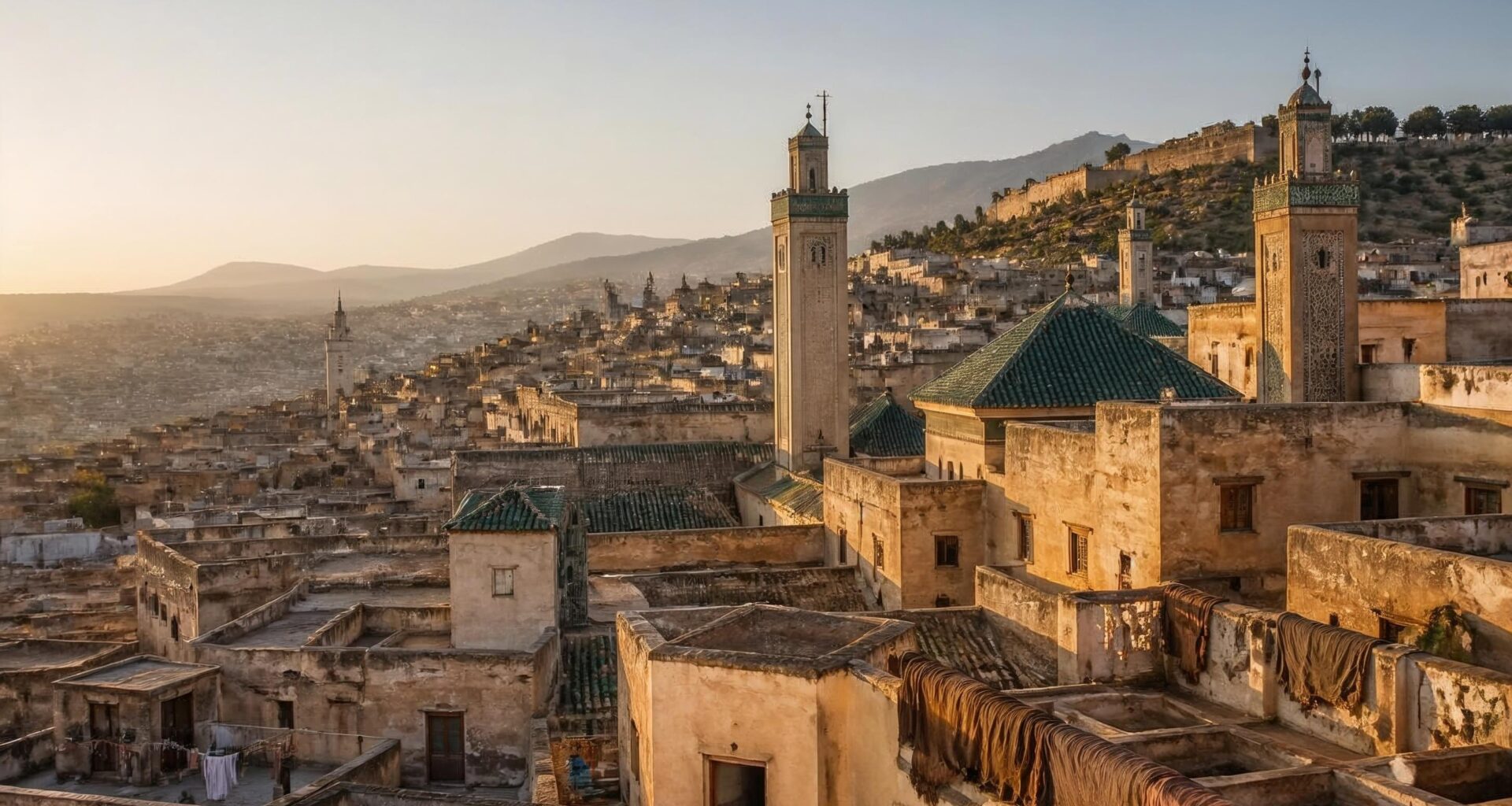
These layers explain why a viewpoint over Fes is so useful. The city is easier to understand when you can distinguish the bowl of Fes el-Bali, the later royal quarter and the broad avenues of the modern city. The contrasts are not evidence that one part is “authentic” and another is not; they show how Fes continued to adapt.
A medina that still works
UNESCO inscribed the Medina of Fez on the World Heritage List in 1981. Its importance lies in both monuments and the survival of an urban fabric where homes, worship, trade and production remain interwoven.
That living quality requires respectful expectations. A narrow lane is not a museum corridor. It may be a delivery route, a workplace entrance or someone’s doorstep. Pack animals and handcarts still move goods where vehicles cannot. Workshops cluster by activity, and many skills pass through families or apprenticeships.
The tanneries are the most photographed example, but they are only one part of the craft economy. Metalworkers, woodcarvers, embroiderers, potters, weavers and leather workers all contribute to the city’s identity. Our Morocco souks guide explains how to browse and bargain without treating every conversation as a contest.
What the gates and streets reveal
Bab Boujloud is a familiar entrance, but the deeper story appears in the relationship between streets. Larger commercial routes connect gates and markets. Smaller lanes branch toward workshops, fountains, mosques and residential passages. Covered sections manage sun and heat, while blank exterior walls protect the privacy of homes whose richest spaces often face inward.
Look for transitions rather than isolated landmarks: the sound changing as a lane narrows, the shift from food stalls to metalwork, the appearance of carved cedar around a religious building, or the tiled fountain that once served a neighbourhood. These observations explain the medina better than rushing between a checklist of monuments.
How to experience Fes responsibly
Start early, when deliveries and workshops reveal how the medina functions. Use a licensed guide if you want historical depth or feel uncomfortable navigating independently; an official guide should carry appropriate identification. Ask before photographing people or active workshops, and accept a refusal without argument.
Dress and behaviour should reflect that Fes el-Bali is home to religious sites and residential communities. Non-Muslims cannot enter every mosque space, so check access instead of following a crowd. During prayer times and Ramadan, allow extra patience and avoid blocking entrances.
Fes rewards a slower visit. The most revealing moments are often not the grandest: bread being carried to a neighbourhood oven, a craftsperson explaining a material, or a resident giving directions through a lane that looks anonymous on a map.
Five useful Darija phrases in Fes
- Hello, peace be upon you. — Salam 3likom.
- Please, where is Bab Boujloud? — 3afak, fin kayn Bab Boujloud?
- May I take a photo? — Wash momkin ntsawer?
- I am just looking, thank you. — Ghir kantfarrej, shukran.
- Goodbye. — Bslama.
Hear and practise more expressions on Darija for Travelers. Regional pronunciation varies, and a polite tone matters more than perfect transliteration.
Why Fes still matters
Fes has survived changes of dynasty, capital and economy because it is more than a collection of monuments. Its institutions connected political authority, faith, education, migration, trade and craft production. The medina remains powerful precisely because those relationships are still legible.
Visit Fes as a living city with historical depth, not as a medieval stage set. That approach produces better questions, more respectful encounters and a clearer understanding of why the city continues to occupy such an important place in Morocco’s cultural imagination.
Sources and verification
Verified 6 October 2026.