Volubilis history cannot be reduced to “Roman ruins in Morocco.” The archaeological site records a much longer conversation between Amazigh, Mauretanian, Punic, Roman, Christian and early Islamic worlds. Its columns and mosaics are striking, but the deeper story is how a prosperous frontier city adapted to changing powers without losing its local identity.
Before Rome: a Mauretanian city
Settlement in the fertile Zerhoun region predates Roman rule. Volubilis developed within the ancient kingdom of Mauretania, whose population and political culture were rooted in North Africa. Mediterranean trade brought outside influences, but the city was not created on an empty landscape by Rome.
This distinction matters. Calling Volubilis only a Roman city hides the indigenous societies that shaped it before annexation and continued to live there afterward.
Volubilis under Roman rule
After Rome annexed Mauretania Tingitana in the first century CE, Volubilis became an important administrative and commercial center near the empire’s southwestern frontier. The surrounding plains supported agriculture, especially grain and olive production. Wealth generated by land and trade helped fund public buildings, private houses and elaborate floor mosaics.
The city followed recognizable Roman urban forms: a basilica for civic business, a capitol associated with official religion, baths, an aqueduct and monumental gates. Yet the people who used these spaces were culturally mixed. Inscriptions, artistic traditions and religious evidence point to a town where Roman institutions met local identities.
Reading the main monuments
The basilica and capitol
These neighboring structures formed the public core. The basilica served legal and administrative functions, while the capitol represented the official religious order of the Roman city. Their elevated ruins dominate many modern views.
The triumphal arch
The arch associated with Emperor Caracalla dates to the early third century. It signaled civic loyalty and status, framing one of the city’s principal streets rather than standing as an isolated decoration.
The houses and mosaics
Several elite residences preserve mosaics with mythological scenes, animals and geometric designs. Names such as the House of Orpheus or House of the Labours of Hercules are modern labels based on surviving imagery. Look down as much as up: Volubilis is one of North Africa’s richest sites for mosaics in their architectural setting.
Olive presses
Pressing installations reveal the economic engine behind monumental life. They connect household wealth to the agricultural landscape that still surrounds the ruins.
After Roman administration
Roman political control weakened and eventually withdrew, but the settlement did not instantly disappear. Communities continued to inhabit the site through late antiquity. Archaeology shows continuity and transformation rather than a single dramatic end.
In the late eighth century, Idris I established power in the region before the rise of nearby Fes. UNESCO notes that Volubilis briefly became a capital under the founder of the Idrisid dynasty. This early Islamic chapter links the site directly to the formation of medieval Morocco.
Why Volubilis became a World Heritage Site
UNESCO inscribed the Archaeological Site of Volubilis in 1997. Its value comes from the visible meeting of cultures over roughly ten centuries of occupation, the survival of a large archaeological landscape and the authenticity created by centuries without dense later construction over the site.
The protected area covers about 42 hectares. Its setting at the foot of Jebel Zerhoun is part of the experience: ruins, fields and distant ridges explain why agriculture and trade flourished here.
How to look at Volubilis responsibly
Do not treat the site as a backdrop alone. Walk the main street, then pause at domestic spaces, presses and drainage channels. The contrast between civic monuments and working infrastructure reveals how the city functioned.
- Stay on marked routes and never climb fragile walls or mosaics.
- Do not touch or move stones.
- Use shade, water and sun protection; much of the site is exposed.
- Allow at least two hours if you want more than photographs.
- Check official opening information and ticket conditions before departure.
Volubilis, Moulay Idriss and Meknes
The ruins are often paired with the hill town of Moulay Idriss Zerhoun and Meknes. The combination makes historical sense: Volubilis introduces ancient and early Islamic layers, Moulay Idriss carries the memory of Morocco’s founding dynasty, and Meknes represents later imperial ambition. Still, each deserves enough time to remain more than a photo stop.
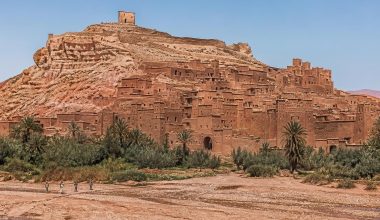
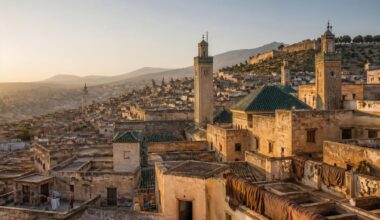
For the wider context, read our history of Fes, Ait Ben Haddou history and practical Fes travel guide.
Five respectful Darija phrases for heritage sites
| English | Darija |
|---|---|
| Can I take a photo here? | N9der nsawwer hna? |
| Can I come in? | N9der nedkhol? |
| Can I touch it? | N9der n9iss? |
| Is this traditional? | Wach hadchi traditionnel? |
| This is truly beautiful. | Hadchi zwin bzzaf |
Practice more phrases for cultural visits in our free Speak Darija lessons.
What Volubilis changes about the story of Morocco
Volubilis shows that Moroccan history is neither isolated nor linear. Local communities absorbed Mediterranean forms, transformed them and carried the region into new religious and political eras. The site belongs to Roman history, but it also belongs to Amazigh history, African history and the beginnings of Islamic Morocco. That layered identity is the real reason to visit.
Historical information reviewed: October 8, 2026.
Sources