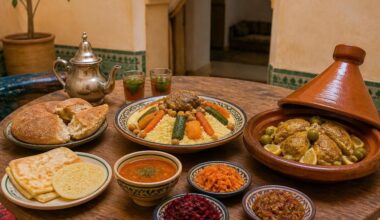
A Moroccan breakfast is less a single national plate than a family of breads, pancakes, spreads, eggs and hot drinks. What appears on the table changes between homes, cafés, cities and regions, but the meal usually favors sharing, tearing bread by hand and combining sweet and savory bites.
What a typical Moroccan breakfast looks like
At a simple café, breakfast may be bread or msemen with butter, jam, honey or cheese, accompanied by mint tea, coffee or fresh orange juice. A guesthouse may serve several breads, eggs, olives, yogurt and seasonal fruit. Home breakfasts are often more economical and repetitive: good bread, olive oil and tea can be enough.
The useful lesson for travelers is not to search for one “authentic set.” A modest neighborhood café and a generous riad spread can both be Moroccan; they answer different routines.
The breads and pancakes to recognize
Khobz
The round everyday loaf is the foundation of many meals. Pieces are torn and used to scoop olive oil, amlou, cheese or eggs. Bread is treated with respect, so avoid wasting it.
Msemen
This layered square flatbread is folded with oil and semolina before cooking on a griddle. It is crisp at the edges and chewy inside, commonly served with honey, butter or soft cheese.
Baghrir
Known for its many tiny holes, baghrir is a soft semolina pancake that absorbs melted butter and honey. It is usually lighter and more delicate than msemen.
Harcha
Harcha is a griddled semolina bread with a crumbly texture. It can be split and filled, or served simply with butter, honey, jam or cheese.
Amlou, olive oil and other spreads
Amlou is traditionally made from almonds, argan oil and honey. It is rich, nutty and particularly associated with southern Morocco. Travelers with nut allergies should not assume any spread is safe; ask clearly about ingredients and cross-contact.
Good olive oil with bread is one of the simplest breakfasts. You may also see butter, honey, jam, soft cheese and olives. These are placed in small shared dishes, so take a sensible amount and add more if needed.
Eggs and savory choices
Eggs may be boiled, fried or cooked in a small tagine with tomato and spices. In busy local cafés, an omelet and bread can be a dependable, filling start. Some establishments also serve bissara, a thick fava-bean soup, especially in cooler weather or in northern cities.
Tea, coffee and juice
Moroccan mint tea is commonly sweetened in the pot. If you want less or no sugar, ask before it is prepared. Coffee styles range from espresso to café au lait and café nous-nous, a half-coffee, half-milk drink. Fresh orange juice is common in tourist centers, but quality and hygiene vary; choose places with clean equipment and steady turnover.
How to order breakfast confidently
Look at what other tables are eating and ask what is included before ordering a “formula.” Menus may bundle a hot drink, juice, bread and eggs, while individual items can be cheaper if you want a light meal. In places without a printed menu, confirm the price first.
Dietary labels do not always map perfectly across languages. “Vegetarian” may still include eggs or dairy, and pastries may contain butter. Explain the ingredient you avoid rather than relying only on a category. See our Moroccan food guide for more dishes and our practical eating guide for hygiene and ordering tips.
Five Darija phrases for breakfast
| English | Darija |
|---|---|
| The menu, please. | Lmenu 3afak |
| What do you recommend? | Chno katnse7ni nakhod? |
| I’d like to try a Moroccan dish. | Bghit ndou9 chi makla mghribiya |
| A mint tea without sugar, please. | Atay b nne3na3 bla sokkar 3afak |
| The bill, please. | L7sab 3afak |
Practice more useful restaurant phrases in our free Speak Darija lessons. The complete Restaurants and Cafés audio lesson will be added to the learning hub when it is ready.
Breakfast etiquette
- Use the bread basket for the table, but take only what you will eat.
- Ask before photographing staff or other guests.
- Pouring tea from height is normal; it aerates the drink and creates foam.
- During Ramadan, daytime service outside tourist areas may be limited. Be discreet around people who are fasting.
- Leave shared dishes tidy and avoid touching food you will not take.
What to choose on your first morning
Order one msemen or baghrir, bread with olive oil or amlou, eggs if you want something savory, and tea or coffee. That combination introduces the textures of a Moroccan breakfast without over-ordering. On later mornings, try harcha, bissara or the regional specialty your host recommends.
Last reviewed: October 8, 2026.
Sources and context
- Moroccan National Tourist Office
- PickYo editorial food research and common Moroccan café practice; individual recipes and service vary by region and establishment.