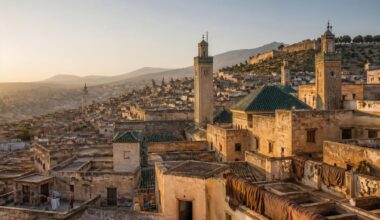
Ait Ben Haddou is a fortified earthen settlement in southern Morocco’s Ounila Valley. Its compact walls, corner towers, communal buildings and layered homes preserve an important example of pre-Saharan architecture. UNESCO added the ksar to the World Heritage List in 1987 for its architectural value and its testimony to a traditional way of life.
Many visitors first recognize Ait Ben Haddou from cinema, but film fame is only one recent chapter. The settlement matters because it explains how communities organized defense, housing, trade, worship and food storage along a historic route between the Sahara and Marrakesh.
Ksar or Kasbah?
A ksar is a fortified village containing multiple houses and shared spaces inside defensive walls. A kasbah usually refers to a fortified residence, citadel or powerful family’s stronghold. Ait Ben Haddou is therefore more accurately called a ksar, even though travelers often use “kasbah” for the entire site.
This difference changes how you read the place. Ait Ben Haddou was not one palace. It was a settlement with domestic buildings, community functions and spaces connected to agriculture and trade.
A Settlement on a Caravan Route
The Ounila Valley formed part of a route linking the ancient Sudan region south of the Sahara with Marrakesh through the Draa Valley and the Tizi n’Telouet. Caravans moved goods, people and ideas through this landscape. The ksar’s elevated, defensible position and storage spaces suited a place exposed to both opportunity and risk.
UNESCO notes that no surviving structure appears earlier than the seventeenth century, although the building techniques and settlement pattern are older. That distinction is important: the site embodies a long architectural tradition without requiring every wall to be ancient.
How the Architecture Works
The buildings use earth, clay, straw and timber sourced from the surrounding region. Thick earthen walls help moderate heat, while closely packed structures reduce exposed surfaces. Decorative upper sections and geometric relief give important façades a distinctive finish without separating beauty from function.
The outer defensive wall is reinforced by angular towers. Inside, narrow passages climb between attached houses. The visual unity comes from shared materials and methods rather than a single master plan. Repairs are part of the architecture because rain and erosion continually affect earthen surfaces.
Community Spaces Inside the Ksar
UNESCO identifies a mosque, a public square, areas outside the walls used for threshing grain, two cemeteries, a sanctuary, lofts and a caravanserai. Together, these features show a complete social landscape rather than a collection of scenic façades.
Homes also reflected differences in status and household size. Some were modest, while larger residences included interior courtyards and more elaborate decoration. The ksar’s meaning lies in this relationship between private homes, shared institutions and the cultivated valley below.
Why Ait Ben Haddou Is Vulnerable
Earthen architecture can last for centuries when it is maintained, but it is vulnerable to heavy rain, erosion, unsuitable cement repairs and abandonment. Tourism brings income and attention, yet uncontrolled foot traffic or commercial alteration can also weaken the site’s character.
Responsible conservation is not simply about freezing the settlement. It requires compatible materials, skilled local knowledge and a role for the community connected to the place. A recently repaired surface may be more authentic to this living building tradition than an older wall left to collapse.
The Film Connection
Ait Ben Haddou’s silhouette and proximity to Ouarzazate helped make it a familiar filming location. Cinema increased international recognition, but it can also encourage visitors to treat the ksar as a set. Look beyond screen associations: the architecture, caravan history and valley community are the real subject.
How to Visit Respectfully
- Use established paths and do not climb fragile walls or roofs.
- Ask before entering a private doorway or photographing residents.
- Pay clearly stated entrance or guide fees rather than following unsolicited offers.
- Carry water and sun protection; exposed slopes can be hot.
- Allow time to observe construction details instead of rushing to the summit.
Access conditions can vary with river level, weather and conservation work. Verify locally on the day. If you are arriving from Marrakech, read our Marrakech travel guide and broader Morocco travel guide before planning the road journey.
Five Useful Darija Phrases
These phrases help you ask simple questions respectfully. For pronunciation and complete themed lessons, visit Speak Darija.
| English | Darija |
|---|---|
| What is this place called? | Shnu smit had l-blasa? |
| How old is it? | Shhal f-omro? |
| May I take a photo? | Nqder ntswwer? |
| Where is the entrance? | Fin kayn l-mdkhal? |
| Thank you | Shukran |
How to Read the Site
Begin with the entire silhouette from the valley floor. Then notice the defensive edge, gateways and towers. Inside, look for how lanes manage slope and shade, how walls connect, and where decoration marks a prominent residence. Finally, look back from higher ground to understand the relationship between the ksar, fields and route through the valley.
Why It Belongs in Morocco Portraits
Ait Ben Haddou is more than a stop between Marrakech and the desert. It is a portrait of adaptation: local earth turned into architecture, a trade route turned into settlement, and recurring maintenance turned into cultural continuity. Understanding those layers makes the view more meaningful.
Information checked: 7 October 2026. Access, conservation zones and local visitor arrangements can change.
Source