Morocco is easy to explore when you match the transport mode to the route. Trains are usually the simplest choice between major cities on the rail network. Coaches fill many gaps, while shared grand taxis serve regional routes. A rental car gives the most flexibility for rural areas but adds driving and parking stress.
For a typical first trip linking Casablanca, Rabat, Tangier, Fes and Marrakech, you can travel comfortably without renting a car. For the Atlas, small villages or a self-directed southern route, a car or carefully chosen transfer becomes more useful.
Quick answer
- Choose trains for major cities on the ONCF network.
- Choose coaches for destinations without a railway station.
- Use petit taxis for short trips within one city.
- Use grand taxis for shared or private intercity and regional trips.
- Rent a car for flexibility outside the main transport corridors.
- Consider a domestic flight only when it meaningfully reduces a very long overland journey.
Morocco transport comparison
| Mode | Best for | Main advantage | Main limitation |
|---|---|---|---|
| Train | Casablanca, Rabat, Tangier, Fes, Marrakech and other rail cities | Comfortable and straightforward | Does not reach every destination |
| Coach | Agadir, Chefchaouen and many towns beyond rail | Broad network | Journey times depend on traffic and stops |
| Petit taxi | Short urban journeys | Convenient door-to-door travel | Stays within its licensed city area |
| Grand taxi | Regional links and flexible transfers | Reaches routes not covered directly by rail | Shared departures and luggage arrangements can vary |
| Rental car | Rural areas, Atlas and flexible road trips | Control over route and stops | Parking, navigation and driving responsibility |
| Private transfer | Airports, families, late arrivals, complex legs | Predictable pickup | Usually the most expensive land option |
| Domestic flight | Selected long-distance city pairs | Saves time on some routes | Airport time can erase the benefit on shorter routes |
Trains: the easiest option between major cities
ONCF operates Morocco’s passenger rail network. The network is particularly useful along the Atlantic and northern corridor and for links to Fes and Marrakech. The high-speed Al Boraq service connects Tangier with Kenitra, Rabat and Casablanca, while conventional Al Atlas trains cover other major routes.
The official tourism office notes that Marrakech is on the rail network while destinations such as Agadir and many smaller towns are not. For places beyond the tracks, combine the train with a coach or transfer.
How to book a Moroccan train
Use the official ONCF Voyages website or app to check current schedules and buy tickets. Tickets are also sold at station counters and, where available, machines. Booking ahead is sensible for busy dates and can provide access to better advance fares; never rely on an old fare quoted in a blog post.
Keep the booking confirmation available offline and confirm the departure station. Casablanca, for example, has more than one station, and choosing the wrong one can add unnecessary stress.
First or second class?
Both can work well. First class generally provides a quieter environment and more predictable seating arrangements; second class is the budget choice. The precise carriage configuration depends on the service, so check what the selected ticket includes instead of assuming every train is identical.
Train travel tips
- Arrive with enough time to read the platform displays.
- Keep valuables with you rather than in an unattended bag.
- Carry water, especially for longer conventional services.
- Do not plan a tight airport connection after a long rail journey.
- Recheck the timetable close to travel in case of engineering work or special operations.
See the detailed Morocco Train Guide.
Coaches: essential beyond the railway
Intercity coaches reach many destinations that trains do not. CTM, Supratours and other operators serve national and regional routes. For common visitor journeys such as Marrakech–Agadir or Fes–Chefchaouen, a coach can be more direct than combining several modes.
Operator terminals are not always next to the train station or city center. Check the exact departure point before the day of travel, especially when two companies use different terminals.
What to check before buying
- exact departure and arrival terminals;
- whether luggage is tagged and whether a small luggage charge applies;
- total journey time and planned stops;
- cancellation or modification conditions;
- how early boarding closes;
- whether the route is direct or requires a connection.
Buy through the operator’s official channel where practical. If an online payment fails, allow time to purchase at the terminal rather than using an unverified reseller.
Petit taxis: short trips inside cities
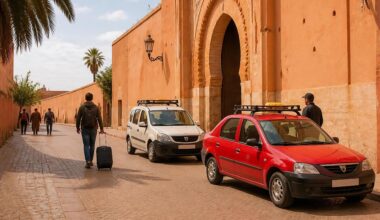
Petit taxis are licensed for urban trips and are usually color-coded by city. They are useful for station transfers, reaching neighborhoods outside walking distance and moving between the medina edge and the modern city.
Ask for the meter to be used where meters apply. At airports or on routes with official fixed systems, follow the posted procedure. Rules and fares can change locally, so city-specific guidance is more reliable than one nationwide price claim.
A petit taxi may pick up another passenger when local practice permits. It will not usually take you on a long intercity route.
Read the full Morocco Taxi Guide.
Grand taxis: regional and intercity travel
Grand taxis connect cities, suburbs and smaller towns. A seat can be purchased in a shared vehicle, or the whole taxi can sometimes be hired privately. Departure points are often dedicated taxi stations rather than arbitrary street corners.
Confirm three things before loading luggage:
- the destination or final stop;
- whether the price is per seat or for the whole vehicle;
- whether luggage changes the agreed amount.
Standards and vehicle types vary. If comfort, child seating or a guaranteed departure time matters, a pre-arranged transfer may be more appropriate.
Renting a car: flexibility with responsibility
A rental car is most useful when the route includes rural landscapes, scattered stops or accommodation outside transport hubs. Morocco drives on the right. Road signs commonly use Arabic and French, and major roads connect the country north to south.
Driving is not automatically faster inside historic cities. Medina access, parking and dense traffic can make a car a burden in Marrakech or Fes. Consider collecting the vehicle only when leaving the city.
Before accepting the car
- photograph every side, the wheels, glass, fuel level and dashboard;
- check what insurance excess remains;
- confirm the fuel policy and deposit;
- verify that the contract permits the planned road types and regions;
- test lights, air conditioning and spare-wheel equipment;
- ask how breakdown assistance works;
- download offline maps before leaving reliable coverage.
Avoid night driving on unfamiliar rural roads when possible. Build extra time into mountain routes, particularly in poor weather.
Private transfers: when convenience is worth paying for
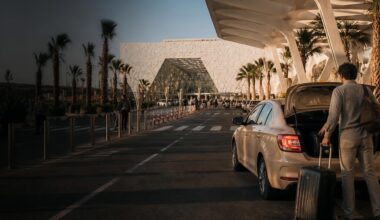
A private transfer can be a sensible choice for a late airport arrival, a family with luggage, a group sharing the cost or an accommodation that is difficult to locate. It is also useful for a one-way rural connection that would otherwise require several changes.
Obtain the total price and inclusions in writing. Confirm the meeting point, waiting-time policy, vehicle size and whether a child seat is genuinely available.
Domestic flights: useful on selected long routes
Domestic flights can reduce travel time between distant regions, but compare the entire door-to-door journey. Airport transfers, check-in, baggage limits and waiting time make flying less attractive for routes already served efficiently by rail.
Check the current schedule directly with the airline. Seasonal frequency can change, and not every apparent city pair is nonstop.
Trams and city buses
Casablanca and the Rabat–Salé area have tram networks. City buses operate more widely, but route information and payment procedures vary. For a short first visit, walking, tram and occasional taxis often form the easiest urban mix.
In medinas, walking is usually the principal mode. Wear stable shoes, save your destination offline and ask your accommodation which gate or landmark is easiest for a taxi pickup.
Best transport for common Morocco routes
Casablanca to Rabat
Train is normally the simplest option. Confirm which Casablanca and Rabat stations best match your accommodation.
Casablanca to Tangier
Al Boraq is the natural first choice. Check the official schedule and fare for your exact date.
Casablanca to Marrakech
Direct conventional trains make this an easy car-free route. Advance booking is sensible at busy times.
Marrakech to Fes
Train avoids the responsibility of a long drive, but the journey consumes much of a day. A stop in Casablanca or Rabat can break up a broader itinerary.
Marrakech to Agadir
There is no passenger railway to Agadir. Coach or private transfer is generally more practical; a rental car is useful if the route continues along the coast or into smaller towns.
Fes to Chefchaouen
Coach or road transfer is the usual solution because Chefchaouen is not on the rail network.
Marrakech to Merzouga
This is a long overland journey, not a quick day trip. Use a multi-day route, coach combination, rental car with realistic stops or an organized trip whose driving hours are disclosed.
A car-free first-time route
A practical route without a rental car can look like this:
- arrive in Casablanca and take the train to Rabat;
- continue by Al Boraq to Tangier;
- use a coach or transfer for Chefchaouen;
- continue by coach to Fes;
- take the train from Fes to Marrakech;
- use a coach for Essaouira or Agadir if adding the Atlantic coast.
Do not copy this sequence blindly. Open-jaw flights, trip length and the season can make the reverse direction more efficient.
Say it in Darija
This travel guide contains five text phrases only. Audio is intentionally reserved for the complete Darija lesson.
| English | Darija in Latin letters |
|---|---|
| Where is the station? | Fin kayna l-mahatta? |
| I want to go to… | Bghit nmshi l… |
| Please use the meter | Khddem l-kontor, afak |
| How much is one seat? | Bshhal blast wahed? |
| Stop here, please | Wqef hna, afak |
Want to hear the pronunciation and learn more useful transport phrases? Continue with Darija Transport Phrases for the complete free lesson with human-recorded audio.
Frequently asked questions
Can tourists use public transport easily in Morocco?
Yes. Trains and major intercity coaches are manageable for independent travelers, especially when tickets and terminals are checked in advance. Smaller regional connections require more flexibility.
Do you need a car in Morocco?
No for a classic city itinerary. A car becomes valuable for rural areas, smaller stops and flexible routes outside the rail and coach network.
Is it better to book Moroccan trains in advance?
Advance booking is wise for popular routes, busy travel dates and when you want a specific departure or class. ONCF promotes advance purchasing and operates the authoritative booking channel.
Can you take a train to Agadir or Chefchaouen?
No direct passenger train serves either destination. Use a coach, transfer or car, potentially combined with rail to the nearest practical hub.
Are taxis expensive in Morocco?
Urban taxis are generally a practical local option, but the correct fare system depends on the city, time and pickup point. Use the meter where applicable or confirm an official/fixed price before departure.
Continue planning
Transport information last checked: 5 October 2026. Always verify live schedules, departure stations and operator policies before booking.
Official Sources