Morocco etiquette is less about memorising a rigid list of rules than recognising the setting you are in. A beach café, family home, village market and mosque entrance do not call for identical behaviour. When unsure, slow down, observe what people around you are doing and ask politely.
Moroccans are accustomed to international visitors, and an honest mistake is rarely a disaster. A greeting, patience and willingness to adjust usually matter more than perfect knowledge of every custom.
Greet before asking
Greetings are an important part of everyday interaction. Begin with salam or salam 3likom before asking for directions, ordering something or starting a negotiation. Even a short greeting makes an exchange feel less abrupt.
Let the other person initiate a handshake, especially across genders. A smile with your right hand placed lightly over your chest is a respectful alternative when no handshake is offered. Friends may greet one another more warmly, but visitors should follow the other person’s lead.
Dress for the setting
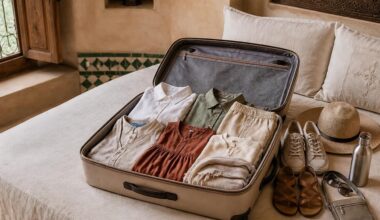
Travelers are not expected to copy local clothing. Morocco is diverse, and clothing norms vary between resort areas, modern neighbourhoods, traditional medinas, rural villages and religious spaces. Loose clothing covering the shoulders, chest and approximately to the knees or below is a versatile choice in more traditional settings.
Beachwear belongs at the beach or pool rather than in shops and streets. Carrying a light overshirt or scarf makes it easy to adapt during the day. Our guide to what to wear in Morocco explains practical choices by season and location.
Ask before taking photographs
A medina, market or workshop is not a film set. Ask before photographing an identifiable person, especially children, craftspeople and vendors. If someone declines, accept the answer immediately. When photographing performers or entertainers, agree on any expected payment before taking the picture.
Avoid photographing police officers and sensitive military or government locations. In religious spaces, never photograph people while they are praying unless you have clear permission and the setting explicitly allows photography.
Tea, meals and hospitality
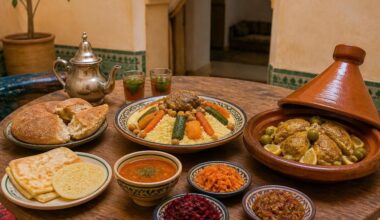
Mint tea is a familiar expression of welcome. Accept when circumstances allow, or decline warmly when you cannot stay. A shopkeeper offering tea does not automatically oblige you to buy anything, although it is polite not to treat the invitation dismissively.
When sharing a communal dish, wait for the host to begin and eat from the section directly in front of you. Use the right hand for eating, receiving food or passing shared objects when practical. During a home visit, follow the host’s lead about removing shoes and where to sit. See our Moroccan food guide for dishes, dining customs and ordering advice.
Visiting a Moroccan home
If you are invited to a family home, arrive with enough flexibility for the visit to last longer than a quick appointment. A modest gift such as pastries, fruit or flowers is thoughtful but not compulsory. Avoid bringing alcohol unless you already know that your host welcomes it.
Compliments are appreciated, but avoid intrusive questions about income, marriage or politics when you have only just met. Hospitality can be generous and spontaneous; you may still decline an invitation if you feel uncomfortable or cannot stay. Keep control of your documents, transport and return plans.
Religious spaces and Ramadan
Most active mosques in Morocco do not admit non-Muslim visitors, with a small number of well-known exceptions. Check access rather than assuming, dress modestly, lower your voice and respect any request to remove your shoes.
During Ramadan, non-Muslim visitors are not generally expected to fast. However, conspicuous public eating, drinking or smoking during fasting hours may cause offence in traditional areas. Restaurants and attractions can change their opening hours, and traffic becomes busier shortly before sunset. Allow extra patience and avoid interrupting someone at prayer time.
Bargaining without turning it into a battle
Bargaining is normal in many souks, but not in supermarkets, pharmacies, restaurants or shops displaying fixed prices. Negotiate lightly and only when you are genuinely interested in buying. Asking for a price, making an offer and then walking away politely are all normal; insulting the product or seller is unnecessary.
Clarify the total price before accepting a service, photograph, guided walk or taxi without a meter. Our Morocco souks guide covers bargaining in detail, while the guide to common Morocco scams and hassles explains how to set boundaries calmly.
Personal space and public behaviour
Public displays of affection are usually more restrained than in many Western countries, particularly in traditional neighbourhoods and rural areas. Holding hands is generally less sensitive than prolonged kissing or intimate behaviour. Loud arguments, drunken behaviour and aggressive gestures attract negative attention almost anywhere.
Same-gender friends may walk arm in arm or greet affectionately without this carrying the same meaning an international visitor might assume. Avoid judging local interactions through your own cultural expectations.
Five useful Darija phrases
- Peace be upon you. — Salam 3likom.
- Please. — 3afak.
- Thank you very much. — Shukran bzaf.
- May I take a photo? — Wash momkin ntsawer?
- No, thank you. — La, shukran.
Listen to pronunciation and learn more free phrases on Darija for Travelers.
The rule that covers most situations
Greet, observe, ask and accept the answer. Respect works in both directions: local customs deserve consideration, and travelers may also protect their time, money and personal boundaries. A sincere apology and willingness to adjust will take you further than trying to perform every custom perfectly.
Sources and verification
Verified 6 October 2026.