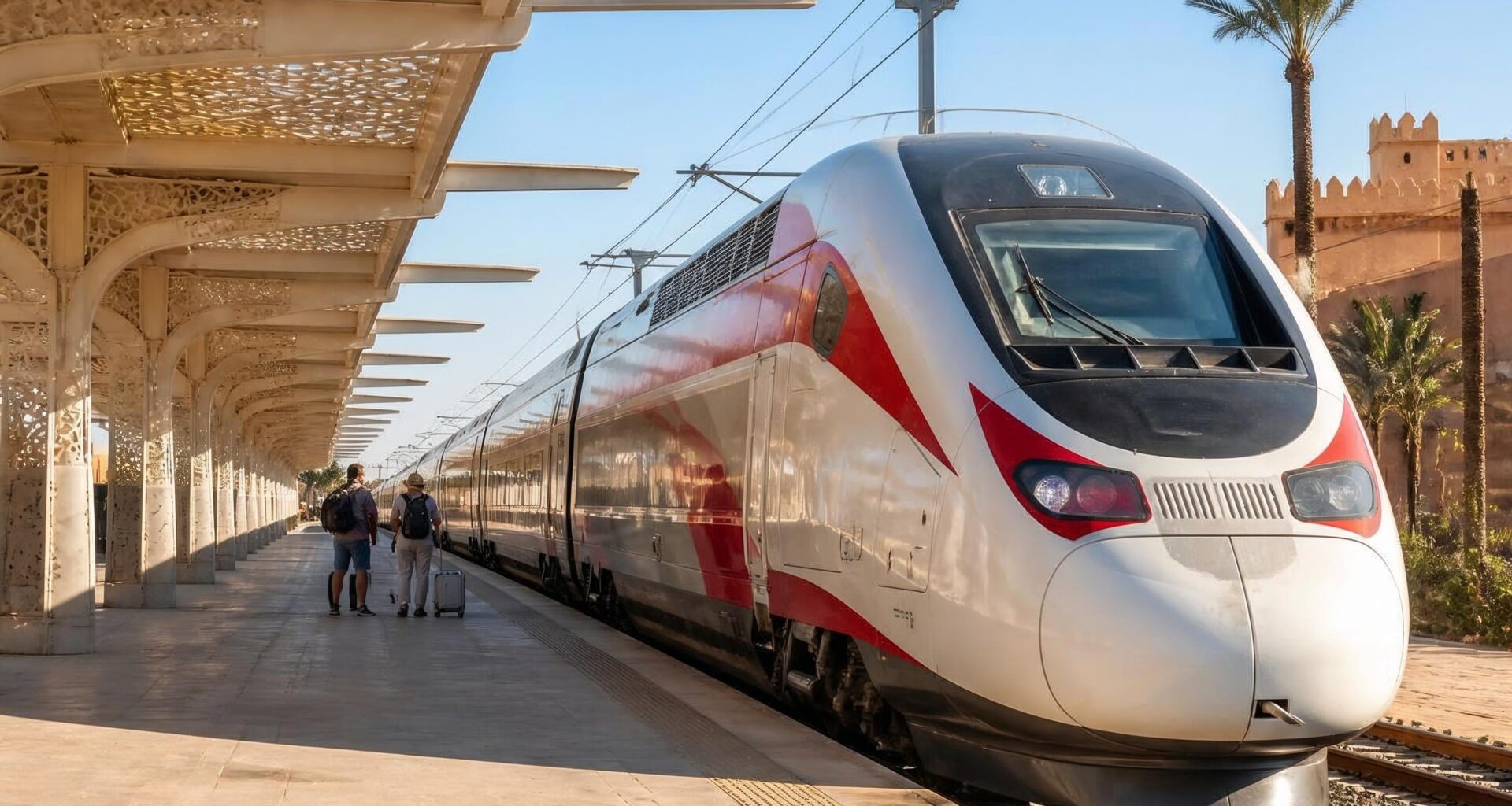
Morocco’s trains are one of the easiest ways to travel between major northern and central cities. The network is particularly useful for Tangier, Rabat, Casablanca, Meknes, Fes and Marrakech. It does not reach every major destination, so a realistic plan often combines a train with a coach or taxi.
The national operator is ONCF. Use the official ONCF journey planner for current schedules and prices rather than copying a timetable from an old travel article.
Morocco Trains at a Glance
| Question | Short answer |
|---|---|
| Official operator | ONCF |
| Official booking site | oncf-voyages.ma |
| High-speed service | Al Boraq between Tangier, Kenitra, Rabat and Casablanca |
| Main conventional service | Al Atlas and other ONCF services |
| Online tickets | Available for eligible journeys; smartphone QR code is accepted |
| First or second class | Both are usable; first class is mainly valuable for space and a calmer long journey |
| Advance booking | Recommended for a fixed itinerary, busy periods and reserved services |
| Train to Agadir, Essaouira, Chefchaouen or Merzouga | No direct railway service; continue by coach or road transport |
Where the Train Is Most Useful
The railway is strongest along the Tangier–Rabat–Casablanca corridor and the conventional lines connecting Casablanca with Marrakech and Fes.
ONCF’s Al Boraq service directly links Tangier, Kenitra, Rabat Agdal and Casa Voyageurs. Connections at Kenitra and Casablanca extend the practical network to Meknes, Fes, Marrakech and other cities.
For a first trip without a rental car, routes such as Tangier–Rabat, Rabat–Casablanca, Casablanca–Marrakech and Casablanca–Fes are straightforward starting points.
Cities commonly reached by train
- Tangier;
- Kenitra;
- Rabat;
- Casablanca;
- Marrakech;
- Meknes;
- Fes;
- El Jadida;
- Oujda and Nador through the eastern network;
- Casablanca Mohammed V Airport through the airport rail connection.
Always verify the exact service and any connection for your travel date on the official journey planner.
Where the Train Does Not Go
Morocco’s railway map leaves several popular tourist destinations outside the direct network.
Agadir
There is no passenger train station in Agadir. Travelers commonly take the train to Marrakech and continue by coach or use a direct coach from another city when available.
Essaouira
There is no direct train. Continue by coach or road transport, often from Marrakech.
Chefchaouen
There is no direct train. Depending on the route, travelers continue by coach or taxi from Tangier, Tetouan or Fes.
Merzouga and the Sahara
There is no direct train to Merzouga. The final section requires a coach, shared taxi, rental car or arranged transfer. Treat claims of a simple “train to the Sahara” with caution.
Al Boraq: Morocco’s High-Speed Train
Al Boraq operates on the Tangier–Kenitra–Rabat–Casablanca corridor. ONCF identifies the direct stops as Tangier, Kenitra, Rabat Agdal and Casa Voyageurs.
It is particularly useful when combining northern Morocco with Rabat or Casablanca. A journey to Marrakech or Fes may involve a conventional onward train, so check whether the itinerary requires a change rather than assuming the same train continues.
ONCF states that Al Boraq tickets can be sold up to three months ahead. Seats are assigned, and the booking process may offer preferences such as window, aisle, solo or facing seats depending on the class and availability.
Al Atlas and Conventional Trains
Conventional ONCF services cover the longer network beyond the high-speed corridor. They connect Marrakech, Casablanca, Rabat, Meknes and Fes and serve many intermediate stations.
These trains are useful but should not be judged by high-speed journey expectations. A long route such as Marrakech to Fes crosses a large part of the country and takes a substantial portion of the day. Check the live schedule before committing to a same-day activity after arrival.
How to Buy a Morocco Train Ticket
Online
Use the official booking platform at oncf-voyages.ma. Search with the exact departure and arrival stations, date, passenger number and preferred class.
ONCF says online buyers receive an electronic confirmation and can present the 2D code on a smartphone to the controller. Printing is not required when the mobile code is available and readable.
After purchasing, verify:
- travel date;
- departure time;
- departure and arrival stations;
- class;
- train number;
- carriage and seat when assigned;
- exchange and refund conditions of the selected fare.
Save the ticket offline and take a screenshot of the code in case mobile data is unreliable at the station.
At the station
Tickets can also be purchased at staffed counters and, where available, ticket machines. ONCF lists cash and card among the station payment options, but a traveler should still carry a backup payment method.
Buying at the station is useful when plans are flexible or an online payment fails. For an important departure, arrive with enough time to find the correct counter, buy the ticket and locate the platform.
Through partner outlets
Some ONCF fares and tickets may be available through approved payment partners. For most international visitors, the official website or station is simpler and easier to verify.
Should You Book in Advance?
Book ahead when:
- your travel date is fixed;
- you are taking Al Boraq or another reserved service;
- you are traveling on a weekend, holiday or busy period;
- you need a particular class;
- missing the train would affect a flight or another reservation.
You can often buy ordinary tickets at the station, but advance purchase reduces uncertainty. It may also provide access to fare options that are unavailable close to departure.
Never publish or rely on a fixed statement that tickets are “always flexible.” Exchange and cancellation conditions depend on the fare selected.
First Class or Second Class?
Both classes are normal public transport, not luxury versus unsafe travel.
Choose first class when
- the journey is long;
- you value a quieter carriage and more personal space;
- you are carrying luggage you want to keep closer;
- you are traveling during a busy period;
- the price difference is acceptable for your budget.
Choose second class when
- the journey is short;
- budget matters more than additional space;
- you are flexible about the seat;
- you are comfortable with a busier carriage.
On Al Boraq, both classes use assigned seating. Exact layouts and benefits can change, so describe the practical difference after inspecting the live booking screen rather than repeating an old seat count.
Choosing the Correct Station
Large cities can have more than one station. “Casablanca” is not a complete instruction.
Casablanca
Casa Voyageurs is the principal long-distance connection for many journeys. Casa Port serves central Casablanca and commuter traffic. Mohammed V Airport has its own rail station. Confirm which station appears on the ticket.
Rabat
Rabat Agdal and Rabat Ville serve different parts of the city. The better station depends on the accommodation and train service.
Tangier
The main passenger station is generally displayed as Tanger Ville on booking systems. Do not confuse the city station with Tangier Med port.
Check the station on a current map before departure and allow time for city traffic.
At the Station
- Arrive early enough to read the departure board without rushing.
- Check the train number and destination, not only the departure time.
- Confirm the platform on the current board because it can change.
- On a reserved service, locate the carriage position before boarding.
- Keep the ticket available for inspection.
- Ask ONCF staff when information conflicts rather than following an unofficial helper.
ONCF specifically advises Al Boraq passengers to check the carriage positioning on the platform and stand nearby.
Luggage on Moroccan Trains
Travelers normally bring their own luggage aboard and place it in available storage areas. Pack so you can lift and move your bags without depending on strangers.
For easier travel:
- avoid blocking doors and aisles;
- keep documents, money and electronics in a smaller bag with you;
- watch belongings during station stops;
- do not leave boarding until the final seconds with heavy luggage;
- confirm current rules directly with ONCF for oversized items, bicycles or unusual equipment.
Common Routes
Tangier to Rabat or Casablanca
This is the ideal use case for Al Boraq. Search the exact date because frequency, journey times and fares can change.
Casablanca to Marrakech
Conventional trains connect the cities. Check whether your departure is from Casa Voyageurs and leave margin if connecting from the airport.
Marrakech to Fes
Direct conventional services may be available, but the journey is long. A daylight departure can be easier for a first visit than arriving deep into the evening.
Casablanca Airport to Marrakech
The airport train does not simply continue as the same service to Marrakech in every case. Search the entire journey and review the required connection, often in Casablanca.
Fes to Chefchaouen
The final journey is by road because Chefchaouen has no railway station. Compare the bus schedule with the train arrival before building a tight connection.
Useful Darija at the Station
| English | Darija in Latin letters | Use |
|---|---|---|
| Where is the station? | Fin kayna l-mahatta? | Ask for directions |
| One ticket to Rabat, please | Wahed tikki l-Rbat, afak | At the counter |
| Which platform? | Ashmen quai? | Ask staff before boarding |
| Is this the train to Fes? | Wash hada train dyal Fes? | Confirm the train |
| Thank you | Shukran | End politely |
The five phrases will remain text-only in this travel guide. For checked pronunciation, station dialogues and free human-recorded audio, continue with Darija Airport and Train Station Phrases.
Common Mistakes
Searching only by city name
Multiple stations can serve the same city. Read the full station name on the ticket.
Using a timetable copied by a blog
Construction, seasonal changes and operational adjustments can make a static timetable obsolete. Link to ONCF and give a verification date.
Assuming every destination has a train
Agadir, Essaouira, Chefchaouen and Merzouga require a road connection.
Booking a tight airport connection
Allow for immigration, baggage, airport train intervals and the connection in Casablanca. A theoretical itinerary is not the same as a safe connection.
Buying from an unofficial helper
Use ONCF’s official website, counter, machine or clearly identified approved seller.
Ignoring the fare conditions
The cheapest option may be less flexible. Check exchange and cancellation conditions before payment.
PickYo’s Recommendation
Use the train for the corridor it serves well: Tangier, Rabat, Casablanca, Marrakech, Meknes and Fes. Book important journeys through ONCF, store the ticket offline and confirm the station name before travel.
For cities outside the railway network, plan the train and road sections as one journey. Leave a realistic connection margin instead of treating two separate tickets as a guaranteed transfer.
Continue Planning
- Getting Around Morocco
- Morocco Taxi Guide
- Marrakech Travel Guide
- Fes Travel Guide
- Chefchaouen Travel Guide
- Darija Airport and Train Station Phrases
Rail information last checked: 5 October 2026. Verify live schedules, fares, stations and ticket conditions with ONCF before booking.
Official Sources